

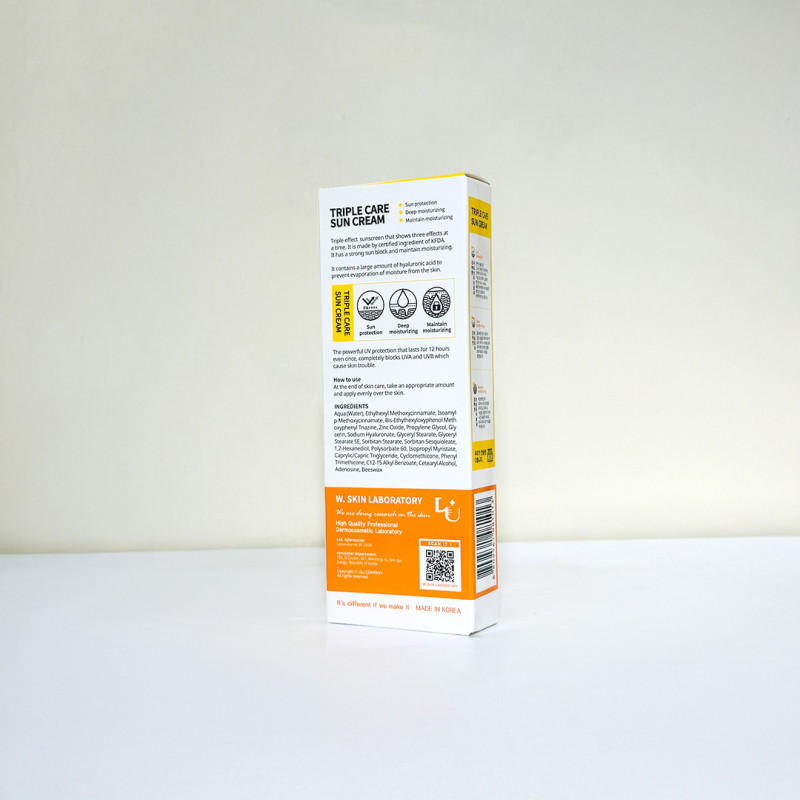
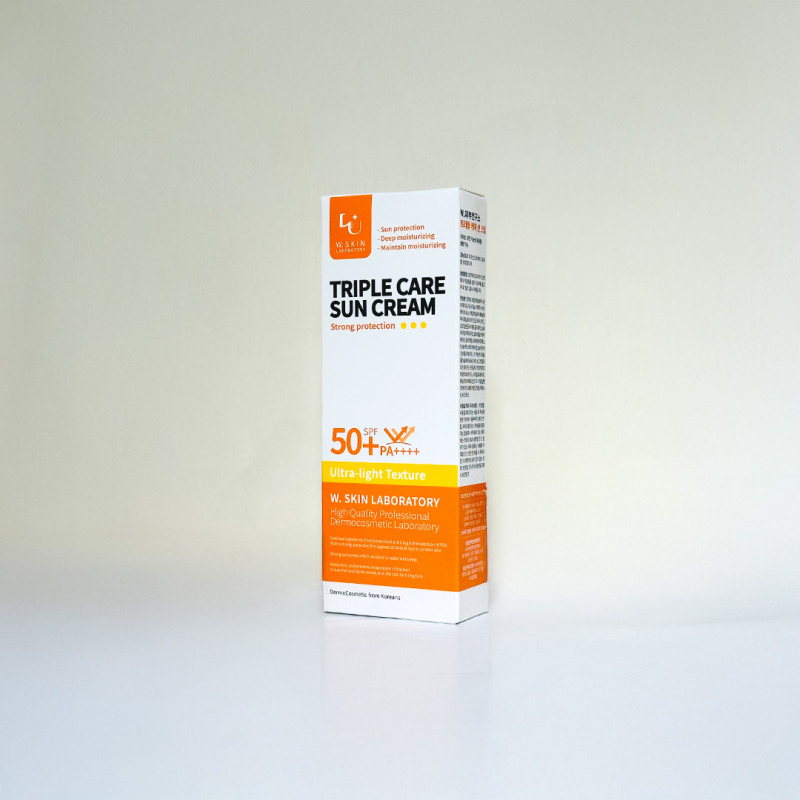
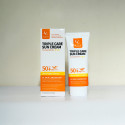
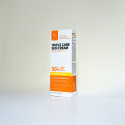
W.Skin Laboratory Triple Care Sun Cream SPF 50+ PA++++ 60 g
৳950
W.Skin Laboratory Triple Care Sun Cream SPF 50+ PA++++ UVA ও UVB রশ্মি থেকে ত্বককে সুরক্ষা দিতে সাহায্য করে। Hyaluronic Acid ও Adenosine ত্বক হাইড্রেটেড, নরম ও মসৃণ রাখতে সহায়তা করে।
- Brand: Care:nel
- Product Code:
- SKU: 8809561081013
- Availability: In Stock
Description
W.SKIN LABORATORY Triple Care Sun Cream SPF 50+ PA++++ is a Korean hybrid sunscreen with four UV filters, registered with Korea’s Ministry of Food and Drug Safety as a UV-protection functional cosmetic — which means its SPF and PA ratings were laboratory tested, not estimated.
It is a well-built sunscreen with a short, clean 22-ingredient list and no fragrance.
It also carries two printed claims that we are going to correct on this page, because following them could get you burned. We would rather sell you a sunscreen you use properly than one you trust too much.
Table of Contents
Why Choose This Sunscreen?
Two Claims on the Box You Should Not Follow
Korea’s UV Functional Registration
The Four Filters — And Which Two Give You UVA Protection
The Amount You Apply Decides Everything
The “Triple Care” Moisturizing Side
Three Ingredients Worth Knowing About
Key Benefits
Key Ingredients and Their Positions
Suitable Skin Types
How to Use
Recommended Skincare Routine
Precautions
Product Details
Buy This Sunscreen in Bangladesh
Official Source
Frequently Asked Questions
Why Choose W.SKIN LABORATORY Triple Care Sun Cream?
The Ratings Are Lab-Tested, Not Claimed
The tube carries Korea’s UV-protection functional cosmetic designation. In Korea, a product cannot print SPF 50+ PA++++ unless those figures have been measured in a registered test and filed with the Ministry of Food and Drug Safety.
That is a real assurance, and it is the main reason to prefer a Korean sunscreen over an unregulated one.
Tinosorb S Is an Excellent Filter to Find Here
Bis-Ethylhexyloxyphenol Methoxyphenyl Triazine — Tinosorb S — is one of the best broad-spectrum filters available. It is highly photostable, and it also stabilises other filters that are not. Its presence is a genuine sign of thoughtful formulation.
Only 22 Ingredients, and No Fragrance
We checked all 22: no parfum, no essential oils, no declared fragrance allergens. For a product you apply to your whole face every single day, that matters more than most people realise.
It Genuinely Moisturizes
Propylene glycol, glycerin and sodium hyaluronate sit at the sixth, seventh and eighth positions — immediately after the filters. Many people can skip a separate morning moisturizer with this.
What We Will Be Straight With You About
The box says the protection “lasts for 12 hours even once” and “completely blocks UVA and UVB.” Neither is true of any sunscreen ever made.
The next section explains what to do instead. Used properly, this is a good sunscreen. Used as the box describes, it will let you burn.
Two Claims on the Box You Should Not Follow
We are putting this first because it is the most important thing on the page.
Claim One: “Protection That Lasts for 12 Hours Even Once”
No sunscreen in the world protects for twelve hours from a single application.
Sunscreen comes off. It is rubbed away by clothing and hands, absorbed into skin, diluted by sweat, and — in the case of organic filters — gradually broken down by the UV light it is absorbing.
The global standard is reapplication every two hours of sun exposure, and immediately after swimming, heavy sweating or towelling.
Please ignore the twelve-hour line completely. Reapply every two hours outdoors. In Bangladesh’s heat and humidity, where you will sweat through a layer faster than in a temperate climate, that is the minimum rather than a cautious maximum.
Claim Two: “Completely Blocks UVA and UVB”
No sunscreen completely blocks ultraviolet light, and none ever will.
SPF 50 filters approximately 98% of UVB. SPF 100 would filter about 99%. The remaining fraction always reaches your skin, which is why dermatologists recommend shade, hats and sleeves alongside sunscreen rather than instead of them.
98% is excellent. It is not complete, and a sunscreen described as complete protection is one people stay out in the sun too long with.
Claim Three, on the Carton: “Resistant to Water and Sweat”
The outer box describes the formula as resistant to water and sweat. But the product carries no tested water-resistance rating.
Water resistance is a separately tested, separately labelled claim — 40 minutes or 80 minutes. Without that label, treat this as a standard sunscreen: reapply after any swimming or heavy sweating, whatever the carton says.
Why We Are Telling You This Rather Than Repeating It
The sunscreen itself is well formulated. Four filters, a strong broad-spectrum one among them, a Korean lab-tested rating and a clean ingredient list.
The marketing copy on the box is simply overstated, as it is on a great many sunscreens. Our job is to sell you the product and tell you how to use it so it actually works.
Korea’s UV Functional Registration
The Korean panel on the tube carries the UV-protection functional cosmetic designation, with the stated efficacy “protects the skin from ultraviolet rays.”
Why This Matters More Than It Sounds
Sunscreen is the one cosmetic category where you cannot tell whether the product works by using it. You feel nothing. You see nothing. You find out months or years later.
Which means the testing is everything.
In Korea, every sunscreen must have its SPF measured on human volunteers and its UVA protection measured as a PPD value, through a registered laboratory, with the results filed before the product can be sold with those numbers on it.
What PA++++ Actually Requires
PA++++ is the highest grade in the system and requires a measured PPD of 16 or above. It is a demanding standard, and it is why Korean sunscreens are generally a safer bet than products from markets with looser rules.
What It Does Not Cover
The registration verifies SPF 50+ and PA++++ at the standard test dose. It says nothing about twelve-hour wear, nothing about complete blocking, and nothing about water resistance.
The number is tested. The marketing around it is not.
The Four Filters — And Which Two Give You UVA Protection
2nd Ethylhexyl Methoxycinnamate (Octinoxate) UVB only
3rd Isoamyl p-Methoxycinnamate (Amiloxate) UVB only
4th Bis-Ethylhexyloxyphenol Methoxyphenyl Triazine (Tinosorb S) UVA + UVB
5th Zinc Oxide UVA + UVB
The Point Worth Understanding
Two of the four filters do nothing for UVA.
Octinoxate and amiloxate are both methoxycinnamates, absorbing in the UVB range around 305 to 310 nanometres. They build the SPF number. They contribute nothing to the PA rating.
The entire PA++++ rating rests on Tinosorb S and zinc oxide.
Is That a Problem?
No — because the product achieved PA++++ in testing, so those two are clearly doing the job. But it is worth knowing which ingredients you are actually relying on for the protection that matters most for ageing and pigmentation.
UVA is the wavelength that penetrates deeper, passes through window glass, and drives photoaging and dark spots. In a sunny climate it is arguably the more important half.
A Genuinely Clever Pairing
Octinoxate is not photostable on its own — it degrades under the very UV light it absorbs, losing effectiveness over the first half hour of exposure.
Tinosorb S is known to stabilise it.
Placing them at the second and fourth positions is a deliberate, well-understood formulation choice. Credit where it is due: this is not a thoughtlessly assembled filter system.
Zinc Oxide at the Fifth Position
Below the three organic filters, so present at a smaller proportion. That is why this does not behave like a mineral sunscreen — the texture is light and the white cast is minimal, which most people will consider a benefit.
Anyone wanting a purely mineral sunscreen should look elsewhere: three of the four filters here are organic.
One Note on Octinoxate
Octinoxate is permitted in cosmetics across the EU, Korea, and most of the world, where it is one of the most widely used UVB filters.
It has been banned in a number of places for environmental rather than skin-safety reasons — Hawaii, Palau, Key West and several Caribbean islands restrict it over concerns about coral reefs. It is not restricted in Bangladesh. We mention it because customers who follow reef-safe guidance will want to know it is here, at the second position.
The Amount You Apply Decides Everything
This section will do more for your skin than anything else on this page.
How SPF Is Measured
SPF is tested at an application density of 2 milligrams per square centimetre of skin. That is the standard, worldwide, without exception.
How Much People Actually Apply
Studies consistently find real-world application at a quarter to a half of that amount.
And the relationship is not proportional. Applying half the tested amount does not give you half the SPF — it gives you roughly the square root. Half of SPF 50 is about SPF 7. A quarter is closer to SPF 3.
Which Means This
A thin layer of SPF 50 sunscreen is not SPF 50. It may not even be SPF 10.
The single most effective thing you can do for your skin is to apply more of the sunscreen you already own. It costs nothing but the product.
How Much Is Enough for a Face
The two-finger rule: squeeze a line of sunscreen along the full length of your index and middle fingers, from base to tip. That is roughly the right amount for face and neck.
It will look like too much. It is not. It should take a moment to spread and should not vanish instantly.
If a 60g tube lasts you six months, you are not using enough. Used correctly on a face and neck daily, a tube this size lasts a month or two.
And the Places People Miss
Ears, the sides of the neck, the back of the neck, the hairline, the eyelids and the tops of the hands. Those are where dermatologists find sun damage, precisely because they are where sunscreen is not applied.
The “Triple Care” Moisturizing Side
The brand’s three claims are sun protection, deep moisturizing and maintaining moisture. The second and third are well supported by the ingredient order.
Humectants Right Behind the Filters
Propylene Glycol (6th), Glycerin (7th) and Sodium Hyaluronate (8th) — all three sit immediately after the UV filters, which is unusually high for a sunscreen.
Sodium hyaluronate at the eighth position is genuinely notable. Many sunscreens place it near the end as a label ingredient; here it is positioned to work.
The Emollient and Texture System
Caprylic/Capric Triglyceride (16th), Cyclomethicone (17th), Phenyl Trimethicone (18th), C12-15 Alkyl Benzoate (19th) and Cetearyl Alcohol (20th).
The two silicones and the alkyl benzoate are why this spreads as lightly as it does. Sunscreen filters are heavy, sticky materials; the “ultra-light texture” on the front of the tube is these ingredients doing their job.
Beeswax — 22nd Position
A structuring wax that helps the film hold together on skin. It also means the product is not vegan — see the note below.
Can It Replace Your Moisturizer?
For most people in a humid climate, yes. With three humectants in the top eight and a full emollient system, this does the work of a light morning moisturizer.
Very dry skin should still apply a moisturizer underneath — and that is better practice anyway, because you are then free to apply the sunscreen generously without worrying about the finish.
Three Ingredients Worth Knowing About
1. Isopropyl Myristate — 15th Position
This is the one we would flag most for customers in Bangladesh.
Isopropyl myristate is an excellent emollient — light, fast-spreading, and part of why this sunscreen feels pleasant. It is also one of the more consistently comedogenic ingredients in cosmetic testing.
If your skin blocks easily, and particularly in hot, humid weather when you are already sweating under a sunscreen layer, this is the ingredient most likely to cause you problems.
Comedogenicity ratings are a rough guide rather than a verdict — plenty of acne-prone people use products containing it without trouble. But patch-test for a week before committing to daily full-face use, and cleanse thoroughly every evening.
2. Beeswax — 22nd Position
The product is not vegan.
For Muslim customers, beeswax is generally considered halal and raises no concern — honey and its products are explicitly permissible. It is only the vegan question that applies here.
3. Octinoxate — 2nd Position
Covered in the filter section above. Permitted in Korea, the EU, and Bangladesh; restricted in several places for coral reef reasons. Worth knowing if reef-safe sunscreen matters to you.
And One Genuine Absence
No fragrance, no essential oils, no declared fragrance allergens anywhere in the 22 ingredients. For a product that goes on your whole face daily and sits under sweat and sun, that is a real advantage over most sunscreens.
Key Benefits of This Sunscreen
Korean Lab-Tested Ratings: SPF 50+ and PA++++ measured and registered, not claimed.
PA++++ UVA Protection: The highest grade in the system, requiring a measured PPD of 16 or above.
Four UV Filters: Including Tinosorb S, one of the best broad-spectrum filters available.
A Photostable Filter Pairing: Tinosorb S stabilises the octinoxate, which is not photostable alone.
Fragrance-Free: Verified across all 22 ingredients.
Short Ingredient List: 22 ingredients, easy to check against sensitivities.
Humectants High in the Formula: Propylene glycol, glycerin, and sodium hyaluronate at the 6th, 7th and 8th positions.
Can Replace a Morning Moisturizer: For most skin types in a humid climate.
Lightweight Finish: Two silicones and an alkyl benzoate keep heavy filters feeling light.
Minimal White Cast: Zinc oxide sits below the organic filters, so this does not behave like a mineral sunscreen.
Adenosine: Korea’s approved wrinkle-improvement active, present as a bonus.
Generous 60g Tube: Enough to apply properly rather than sparingly.
Key Ingredients and Their Positions
Ethylhexyl Methoxycinnamate — 2nd Position
Octinoxate, the primary UVB filter. Builds most of the SPF number. Not photostable alone, which is why the Tinosorb S matters.
Isoamyl p-Methoxycinnamate — 3rd Position
Amiloxate, a second UVB filter. More photostable than octinoxate, and it also helps dissolve the other filters so they spread evenly.
Bis-Ethylhexyloxyphenol Methoxyphenyl Triazine — 4th Position
Tinosorb S — the best filter in this formula. Broad-spectrum across UVA and UVB, highly photostable, and it stabilises other filters. The main contributor to the PA++++ rating.
Zinc Oxide — 5th Position
The mineral filter, adding UVA1 coverage at the longest wavelengths where organic filters are weakest.
Propylene Glycol — 6th, Glycerin — 7th, Sodium Hyaluronate — 8th
Three humectants immediately behind the filters. The “deep moisturizing” claim earns its place here.
Glyceryl Stearate — 9th, Glyceryl Stearate SE — 10th, Sorbitan Stearate — 11th, Sorbitan Sesquioleate — 12th, Polysorbate 60 — 14th
The emulsifier system. Sunscreen filters are difficult to keep stably suspended, and five emulsifiers is what that takes.
1,2-Hexanediol — 13th Position
A multifunctional humectant that also contributes to preservation.
Isopropyl Myristate — 15th Position
A light, fast-spreading emollient. Also the most comedogenic ingredient in the formula — see the note above.
Caprylic/Capric Triglyceride — 16th Position
A stable, light emollient that helps carry the oil-soluble filters.
Cyclomethicone — 17th and Phenyl Trimethicone — 18th
The two silicones responsible for the light, silky feel. They let a heavy filter load spread without dragging.
C12-15 Alkyl Benzoate — 19th Position
An emollient that is also an excellent solvent for UV filters — it helps keep them evenly distributed, which directly affects how well the film protects.
Cetearyl Alcohol — 20th Position
A fatty alcohol thickener. Not a drying alcohol.
Adenosine — 21st Position
Korea’s approved wrinkle-improvement active. A sensible addition to a sunscreen, since UV exposure is the main driver of wrinkles.
Beeswax — 22nd Position
A structuring wax that helps the sunscreen film hold together. Not vegan.
What Is Not In It
No fragrance. No essential oils. No alcohol denat. No exfoliating acids. No declared fragrance allergens.
Which Skin Types Is This For?
A Good Match
Normal and Dry Skin: The clearest fit. Three humectants high in the formula.
Fragrance-Sensitive Skin: Genuinely fragrance-free, which is rare in sunscreen.
Anyone Who Dislikes White Cast: Mostly organic filters, so very little.
Anyone Wanting to Skip Morning Moisturizer: This does both jobs.
Daily Outdoor Exposure: PA++++ is the highest UVA grade available.
Anyone Using Retinoids, Acids or Brightening Products: Daily high-protection sunscreen is what makes those work.
Under Makeup: The silicone base gives a smooth surface for foundation.
Use With Care
Acne-Prone or Congestion-Prone Skin: Isopropyl myristate at the fifteenth position is the concern. Patch-test for a week before daily full-face use.
Very Oily Skin: Workable, but the emollient load may feel heavy in peak humidity. Blotting paper rather than reapplying more product.
Sensitive Skin: No fragrance is a strong start, but some people react to specific UV filters. Patch-test.
Not the Right Choice
Anyone Wanting a Purely Mineral Sunscreen: Three of the four filters are organic.
Anyone Avoiding Octinoxate for reef-safety reasons: it is the second ingredient.
Vegan Routines: Contains beeswax.
Swimming and Water Sports: No tested water-resistance rating. Use a product labelled 40 or 80 minutes water resistant.
Anyone Who Will Not Reapply: Please read the two-claims section again.
How to Use
The Amount Matters More Than Anything Else
Two fingers’ length of product for face and neck. Anything less and you are not getting SPF 50.
Steps
Finish your skincare first. Sunscreen is the last step before makeup.
Squeeze out two fingers’ worth — a line along your index and middle fingers.
Dot it around the face — forehead, both cheeks, nose, chin — before spreading.
Spread in one direction rather than rubbing in circles, so the film stays even.
Do not forget ears, the sides and back of the neck, the hairline and the tops of your hands.
Wait 15 minutes before going out. The film needs to set.
Reapply every two hours outdoors, and after swimming, heavy sweating or towelling.
Cleanse thoroughly at night. A single wash often will not remove a full sunscreen layer.
Reapplying Over Makeup
The honest answer: nothing works as well as reapplying the cream itself.
A sunscreen powder or stick over makeup is better than nothing, but almost nobody applies enough of those to reach the labelled protection. If you are outdoors for a long day, plan to pat this sunscreen over your makeup with clean fingers and accept the touch-up.
Removing It Properly
With four filters, two silicones and beeswax, this is a film built to resist being washed off. Use an oil cleanser or balm first, then your usual cleanser. Sunscreen left on overnight is a common cause of congestion blamed on the sunscreen itself.
And Use It Every Day
UVA passes through cloud and through window glass. Overcast days and desk-by-the-window days still count. Daily consistency matters more than the SPF number.
Recommended Skincare Routine
Morning
Step 1 – Cleanse. Step 2 – Toner. Step 3 – Serum. Step 4 – Moisturizer, if your skin needs it. Step 5 – This sunscreen, two fingers’ worth. Step 6 – Makeup, after 15 minutes.
Evening
Step 1 – Oil cleanser or balm to remove the sunscreen. Step 2 – Your usual cleanser. Step 3 – Toner. Step 4 – Treatment serum. Step 5 – Moisturizer.
If You Use Actives
Retinoids, vitamin C, acids and brightening products all depend on daily sunscreen to deliver results.
Retinoids and acids increase sun sensitivity; brightening treatments are undone by fresh UV exposure faster than they work. Sunscreen is not an optional extra alongside those products — it is the half of the routine that makes the other half worthwhile.
A Practical Note for Humid Weather
Apply sunscreen to cool, settled skin. Applying immediately after a hot shower, while still sweating, gives a patchy film. Wait a few minutes.
Important Usage Tips and Precautions
Do not rely on the “12 hours” claim printed on the box. Reapply every two hours of sun exposure, and after swimming, sweating or towelling.
No sunscreen completely blocks UV. SPF 50 filters about 98% of UVB. Use shade, hats and clothing as well.
Apply two fingers’ length for face and neck. A thin layer of SPF 50 may deliver less than SPF 10.
There is no tested water-resistance rating. Reapply after water contact regardless of what the carton says.
Apply 15 minutes before going outdoors.
Contains isopropyl myristate, a recognised comedogenic ingredient. Patch-test for a week if your skin is congestion-prone.
Contains beeswax. Not vegan (beeswax is generally considered halal).
Contains octinoxate, restricted in some regions for coral reef reasons, though not in Bangladesh.
Remove thoroughly every evening, ideally with an oil cleanser first.
Avoid contact with the eyes. Rinse with water if it gets in.
Do not apply to broken, inflamed or sunburned skin.
Discontinue use if redness, stinging or persistent irritation develops. Some people react to specific UV filters.
Patch-test before first use if your skin is sensitive.
Store away from heat and direct sunlight. Do not leave the tube in a parked car — heat degrades UV filters.
For external use only. Keep out of reach of children.
Follow the expiry date printed on the tube, and replace any sunscreen more than a year past opening.
Product Details
Brand W.SKIN LABORATORY
Product Name W.SKIN LABORATORY Triple Care Sun Cream
Product Category Sun Care / Sunscreen / Face Sunscreen
Product Type Hybrid Mineral and Organic Sunscreen Cream
Korean Registration Functional Cosmetic — UV Protection (Korea MFDS, Lab-Tested Ratings)
SPF SPF 50+ (filters approximately 98% of UVB)
PA Rating PA++++ (highest grade; measured PPD of 16 or above)
Number of UV Filters 4
UVB Filters Ethylhexyl Methoxycinnamate (2nd), Isoamyl p-Methoxycinnamate (3rd)
Broad-Spectrum Filters Bis-Ethylhexyloxyphenol Methoxyphenyl Triazine / Tinosorb S (4th), Zinc Oxide (5th)
Water Resistance No Tested Water-Resistance Rating
Main Humectants Propylene Glycol (6th), Glycerin (7th), Sodium Hyaluronate (8th)
Texture Ingredients Cyclomethicone, Phenyl Trimethicone, C12-15 Alkyl Benzoate
Skin-Conditioning Ingredient Adenosine — 21st Position
Total Ingredients 22
Added Fragrance None — Verified Across All 22 Ingredients
Vegan No — Contains Beeswax
Comedogenic Note Contains Isopropyl Myristate (15th)
Texture Lightweight Cream
Finish Smooth and Non-Sticky; Minimal White Cast
Best For Normal and Dry Skin; Fragrance-Sensitive Skin; Daily Use
Use With Care Acne-Prone and Very Oily Skin
Not Recommended For Swimming; Purely Mineral Sunscreen Routines; Vegan Routines
Product Step Final Morning Skincare Step, Before Makeup
How Much to Apply Two Fingers’ Length for Face and Neck
Reapplication Every 2 Hours Outdoors, and After Sweating or Water Contact
Removal Oil Cleanser or Balm First, Then Regular Cleanser
Packaging Tube With Outer Carton
Available Size 60g
Product SKU 8809561081013
Manufacturer Songhak Cosmetics, Republic of Korea
Responsible Distributor J&J Company Co., Ltd., Daegu, Republic of Korea
Country of Origin South Korea
Buy W.SKIN LABORATORY Triple Care Sun Cream in Bangladesh
Buy W.SKIN LABORATORY Triple Care Sun Cream SPF 50+ PA++++ in Bangladesh from KC BAZAR. A Korean hybrid sunscreen with four UV filters including Tinosorb S, lab-tested SPF 50+ PA++++ ratings registered with Korea’s MFDS, and no fragrance across its 22 ingredients — in a 60g tube, with nationwide home delivery.
Apply two fingers’ worth and reapply every two hours outdoors. That is what turns an SPF 50 label into SPF 50 protection.
Explore more Korean Sun Care at KC BAZAR.
Official Source
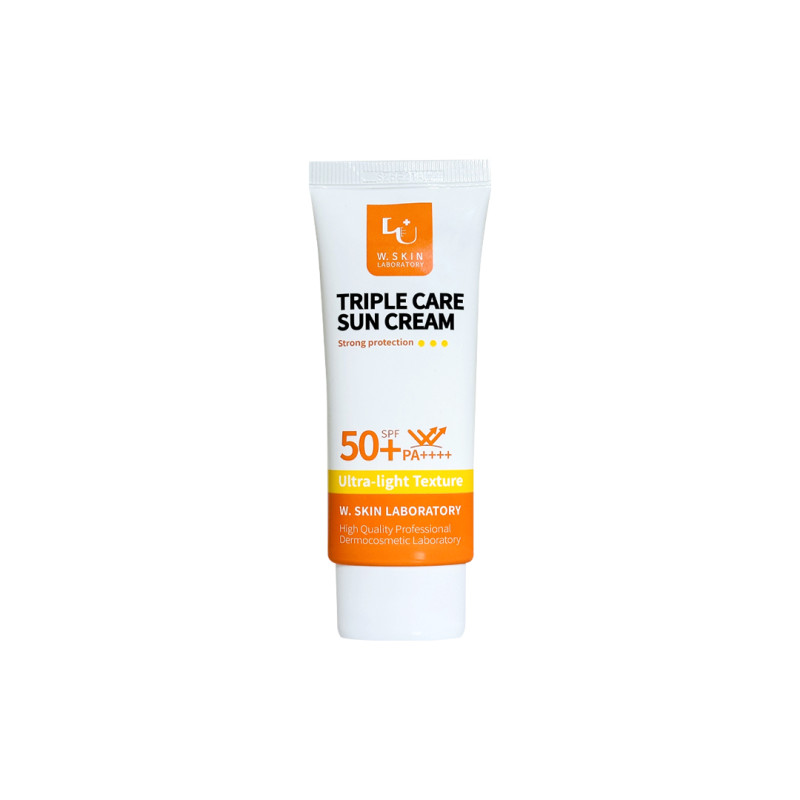
The tube and carton are marked W.SKIN LABORATORY TRIPLE CARE SUN CREAM — Strong protection — SPF 50+ PA++++ — Ultra-light Texture, with MADE IN KOREA and the barcode 8809561081013.
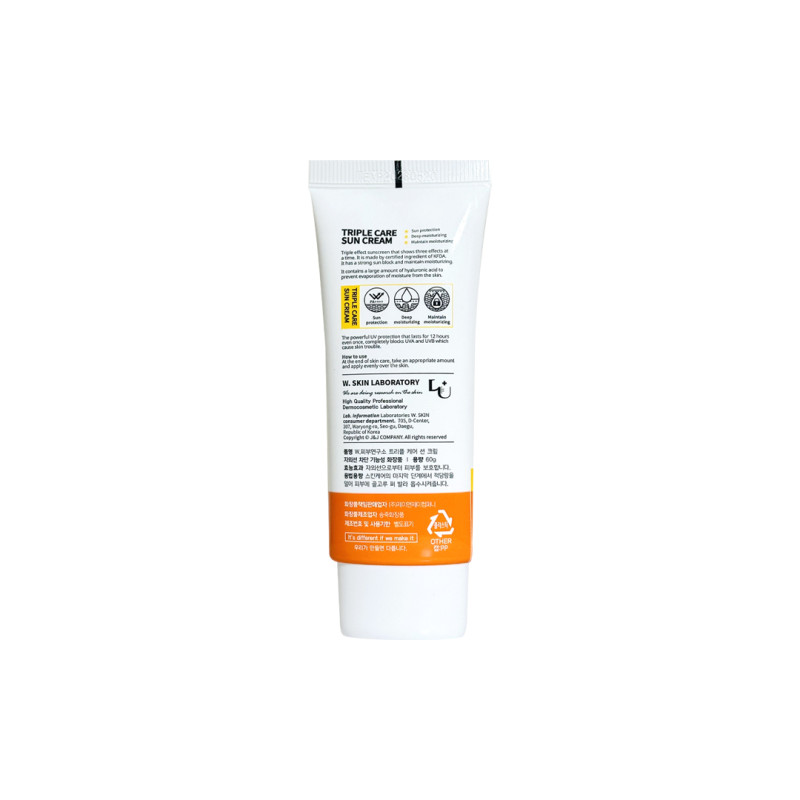
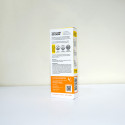
The Korean panel carries the 자외선차단 기능성화장품 designation — a UV-protection functional cosmetic registered with Korea’s Ministry of Food and Drug Safety — with the stated efficacy “protects the skin from ultraviolet rays” and the volume given as 60g.
The directions read: “At the end of skin care, take an appropriate amount and apply evenly over the skin.”
The Korean regulatory panel names Songhak Cosmetics as the cosmetics manufacturer and J&J Company Co., Ltd. as the responsible distributor, with the consumer department address given in Seo-gu, Daegu.
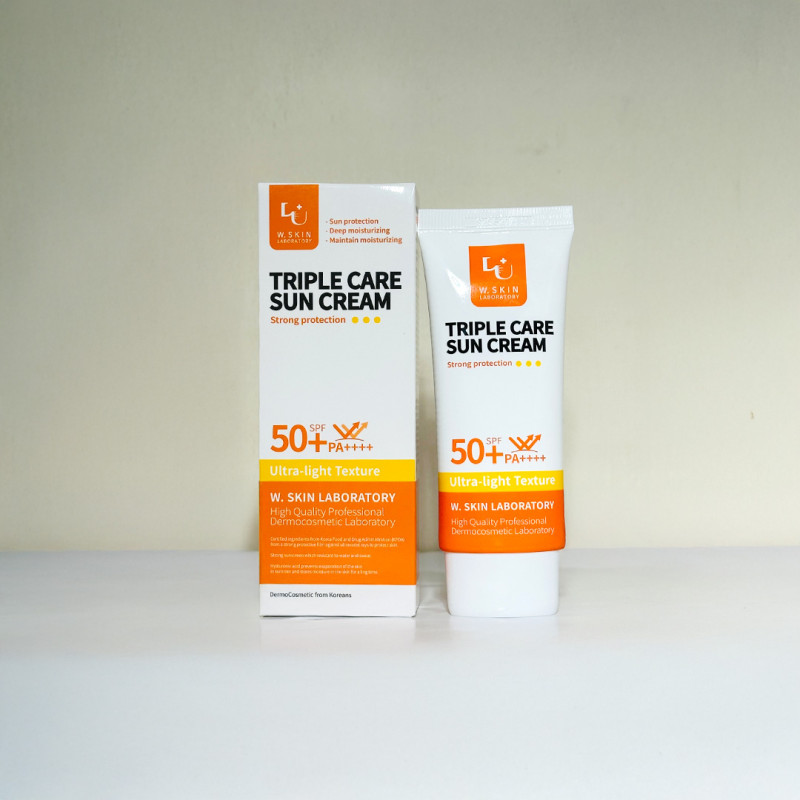
The carton’s English panel states that the product is “made by certified ingredient of KFDA” and lists the three claimed effects as sun protection, deep moisturizing and maintain moisturizing.
The same panel also states that the protection “lasts for 12 hours even once” and “completely blocks UVA and UVB.” We have addressed both claims directly on this page, because no sunscreen protects for twelve hours from one application and none blocks UV completely. The SPF 50+ PA++++ ratings are lab-tested and registered; those two sentences are not.
Frequently Asked Questions
1. The box says 12 hours of protection. Is that true?
No, and please do not rely on it. No sunscreen protects for twelve hours from one application — it rubs off, absorbs, and washes away with sweat. Reapply every two hours outdoors, and sooner in Bangladesh’s heat.
2. Does it completely block UVA and UVB, as the box says?
No sunscreen does. SPF 50 filters about 98% of UVB — excellent, but not complete. Use shade, a hat and sleeves as well, especially in the middle of the day.
3. Are the SPF 50+ and PA++++ ratings reliable?
Yes — those are the trustworthy part. Korea requires sunscreens to have SPF and UVA protection measured in a registered laboratory and filed with the MFDS before the figures can be printed. PA++++ is the highest UVA grade available.
4. How much should I apply?
Two fingers’ length for face and neck — a line along your index and middle fingers. SPF is tested at an amount most people never apply, and a thin layer of SPF 50 can deliver less than SPF 10. This is the single most useful thing on this page.
5. Is it a mineral or a chemical sunscreen?
A hybrid, but mostly organic. Zinc oxide sits at the fifth position, below three organic filters. That is why there is almost no white cast — and why it is not the right choice if you specifically want a mineral sunscreen.
6. Which ingredients give the UVA protection?
Tinosorb S at the fourth position and zinc oxide at the fifth. The two cinnamate filters above them are UVB-only. Tinosorb S is one of the best broad-spectrum filters available, and it also stabilises the octinoxate, which is not photostable on its own.
7. Can I swim in it?
Not reliably. The carton mentions water and sweat resistance, but there is no tested water-resistance rating — that is a separate, separately labelled claim. For swimming, use a sunscreen marked 40 or 80 minutes water resistant.
8. Will it break me out?
It might, if you are congestion-prone. Isopropyl myristate at the fifteenth position is a recognised comedogenic ingredient, and hot humid weather makes that more likely. Patch-test for a week, and always cleanse thoroughly at night.
9. Does it leave a white cast?
Very little. The zinc oxide is below three organic filters, so the formula behaves like an organic sunscreen. Good news for deeper skin tones.
10. Can I skip moisturizer and just use this?
For most people in a humid climate, yes. Propylene glycol, glycerin and sodium hyaluronate sit at the sixth, seventh and eighth positions. Very dry skin should still moisturize underneath.
Food & Supplement


Beauty of Joseon Relief Sun : Rice + Probiotics SPF50+ PA++++
৳1,080 Ex Tax: ৳1,080

Innisfree Intensive Long-Lasting Sunscreen Ex SPF50+ PA++++ 60 ml
৳1,650 Ex Tax: ৳1,650


Medicube Collagen Jelly Cream 110 ml
৳1,700 ৳2,300 Ex Tax: ৳1,700


The Face Shop Natural Sun Eco Super Active Sun Cream SPF50+ PA++++ 50 ml
৳1,400 Ex Tax: ৳1,400


