

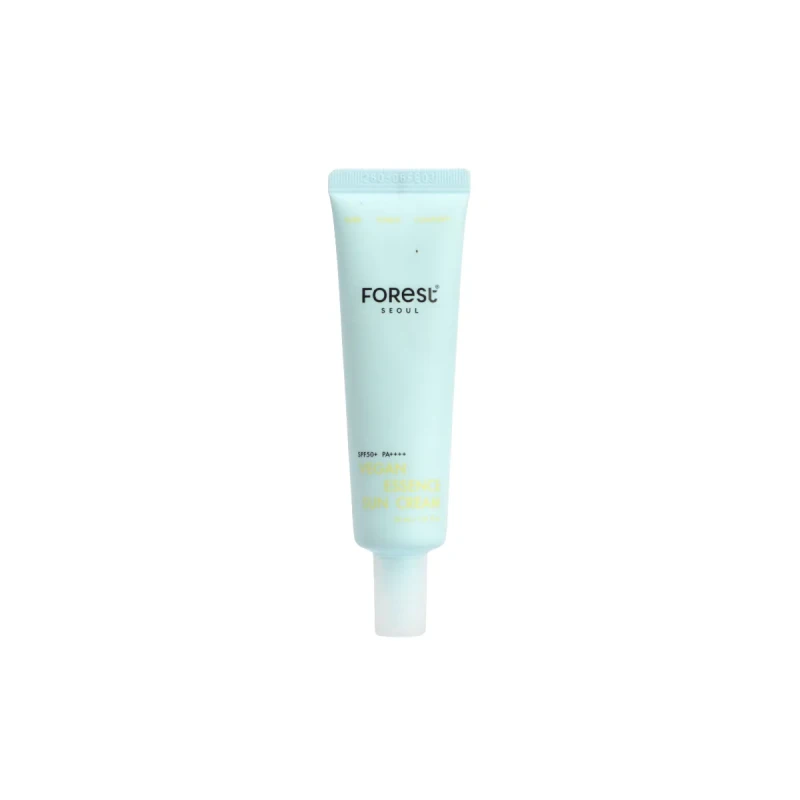


Forest Seoul Vegan Essence Sun Cream SPF50+ PA++++ 30 ml
৳420
Forest Seoul Vegan Essence Sun Cream SPF50+ PA++++ একটি হালকা, হাইড্রেটিং কোরিয়ান সানস্ক্রিন। UVA ও UVB রশ্মি থেকে সুরক্ষা দেয়, ত্বকের আর্দ্রতা বজায় রাখে এবং কম হোয়াইট কাস্টে মেকআপের আগে ব্যবহার করা যায়।
- Brand: Food A Holic
- Product Code:
- SKU: 10000310
- Availability: In Stock
Description
Forest Seoul Vegan Essence Sun Cream SPF50+ PA++++ is a Korean sunscreen with an essence texture. The back panel carries the marking that matters most on any sunscreen: 자외선차단 기능성 화장품 — a UV protection functional cosmetic, registered with Korea’s Ministry of Food and Drug Safety.
Forest Seoul is a brand of Yuhan-Kimberly, and the tube carries the company’s “Keep Our Land Green” emblem — the reforestation campaign it has run since 1984. The pack also states that skin irritation testing was completed by ELLEAD on a panel of more than thirty adults.
The three sections below explain what that regulatory marking actually certifies and why it is worth more than most people realise, the single arithmetic fact that decides whether you get SPF 50 or SPF 7 from this tube, and what an essence-texture sunscreen can and cannot protect you from.
Table of Contents
- Product Overview
- What Korea’s UV Protection Registration Certifies
- The Number That Decides Whether You Get SPF 50 or SPF 7
- What This Sunscreen Protects You From, and What It Doesn’t
- Key Benefits
- Suitable Skin Types
- Texture and Skin Finish
- How to Use
- Recommended Skincare Routine
- Sun Protection in Bangladesh
- Precautions and Storage
- Product Details
- Where to Buy in Bangladesh
- Official Product Information
- Frequently Asked Questions
Product Overview
Forest Seoul is a skincare brand of Yuhan-Kimberly, a long-established Korean company best known in Korea for household and personal care products. The name is not decorative: the tube carries the emblem of “Keep Our Land Green,” the reforestation campaign Yuhan-Kimberly has run continuously since 1984, one of Korea’s longest-running and best-known corporate environmental programmes.
The product is described on the pack as a moisture essence sun cream made with premium clean ingredients found in the green forest, for year-round photoaging care — applied daily like an essence, with a moist texture that coats the skin lightly. The English line on the tube puts it more simply: an essence-texture sunscreen delivering deep hydration and a makeup-friendly finish.
Two further markings appear on the back:
- SPF50+ PA++++, UV protection functional cosmetic — the Korean regulatory registration
- Skin irritation test completed by ELLEAD, on a panel of more than 30 adults
Naming the testing house and the panel size is more disclosure than most brands offer, and the regulatory marking is the single most important thing on any sunscreen pack. The next section explains why.
What Korea’s UV Protection Registration Certifies
Korea regulates four cosmetic claim categories as functional cosmetics: brightening, wrinkle improvement, hair-loss symptom care, and UV protection. This product carries the fourth.
In Korea, a product cannot legally print an SPF or PA figure on its packaging without this registration. That is a meaningfully higher bar than exists in many markets, and it is worth understanding exactly what it requires.
SPF is measured on human skin, not calculated
This surprises people. Sun Protection Factor cannot be worked out from a formula on paper. It is determined by in vivo testing on human volunteers under a standardised protocol:
- A measured dose of sunscreen is applied to a defined area of a volunteer’s back
- Controlled doses of UV are delivered to protected and unprotected areas
- The minimum dose producing visible redness is recorded for each
- SPF is the ratio between them
Two products with similar ingredient lists can test at quite different SPF values, because what matters is how the filters are distributed in the film the product forms on skin — something only measurement reveals.
PA++++ has a precise numerical meaning
The PA rating measures UVA protection, and it is determined by a separate human test: the Persistent Pigment Darkening method, which measures the lasting tanning response rather than redness, because UVA produces far less redness than UVB.
The PA grades map to measured PPD values:
- PA+ — PPD of 2 to under 4
- PA++ — PPD of 4 to under 8
- PA+++ — PPD of 8 to under 16
- PA++++ — PPD of 16 or higher
PA++++ is the highest grade the system has, and it was only introduced in 2013 — before that, PA+++ was the ceiling. It is not a marketing flourish; it corresponds to a measured figure.
Why UVA protection deserves attention separately from SPF. UVA makes up the large majority of the UV reaching ground level, penetrates deeper into the skin than UVB, passes through window glass and cloud largely unaffected, and is the dominant driver of photoaging and pigmentation. It causes much less redness than UVB, which is why a high SPF with poor UVA protection can let you sit in the sun comfortably while damage accumulates invisibly. A high PA rating alongside a high SPF is what makes a sunscreen genuinely broad-spectrum.
What “50+” means — and what it hides
SPF labelling is capped at “50+” in Korea, the EU and Japan. You cannot print SPF 60, 80 or 100. A product that tests at 55 and one that tests at 90 both appear as “50+”.
The cap exists for a good reason: the marginal gain in percentage terms becomes small at the top of the scale. SPF 15 filters around 93 per cent of UVB, SPF 30 around 97, SPF 50 around 98. But the dose that gets through is the more useful way to look at it: SPF 30 transmits one-thirtieth of the UVB, SPF 50 one-fiftieth — so SPF 50 lets roughly 40 per cent less UVB reach your skin than SPF 30. In a climate like Bangladesh’s, that difference is worth having.
And why the registration matters more than you’d think
This is worth saying plainly. Independent laboratory testing of sunscreens in several markets has, on occasion, found products delivering substantially less protection than their labels claimed, and the Korean sunscreen category has had its share of such findings in recent years. SPF testing is expensive and the result cannot be verified by reading a label.
That is precisely why a government registration, requiring human testing to a standardised protocol with the results filed with a regulator, is worth more than an unregulated number. It is the only assurance available to a buyer that the figure on the tube corresponds to a measurement.
The accompanying credential is worth noting too: the pack states a skin irritation test was completed by ELLEAD, a Korean cosmetic testing organisation, on a panel of more than thirty adults. Naming the testing house and the panel size is more than most brands disclose.
The Number That Decides Whether You Get SPF 50 or SPF 7
This section matters more than everything else on this page, because the most common reason a sunscreen fails is not the product — it is the amount.
SPF is tested at a specific dose
The standardised SPF test applies sunscreen at 2 milligrams per square centimetre of skin. That figure is not a suggestion; it is the condition under which the number on the tube was obtained. Apply less, and you get less — not proportionally less, but considerably less.
How much is 2 mg/cm² in practice? For an average adult face and neck, roughly 1.25 grams. That is:
- About a quarter of a teaspoon for the face, with a little more for the neck
- Or, by the two-finger rule: squeeze a continuous line of sunscreen along the full length of your index finger and your middle finger, and use all of it on your face and neck
Almost nobody applies this much. Studies measuring real-world use consistently find people applying between 0.5 and 1.0 mg/cm² — a quarter to half the tested dose.
What under-application actually costs you
Protection does not fall in a straight line with dose. The relationship is closer to a power function, which means halving the amount costs you far more than half the protection.
Applied to this product:
- Full tested dose — SPF 50+
- Half the dose, which many people apply — behaves closer to SPF 7
- A quarter of the dose — behaves closer to SPF 3
You can buy a properly registered, correctly tested SPF 50+ sunscreen and walk out of the house with the protection of an SPF 7. That is not a flaw in the product. It is arithmetic, and it applies to every sunscreen ever made.
The tube test — and this is the part worth remembering
Here is a check you can run on yourself without any equipment.
At 1.25 g per application, a 30ml tube contains roughly 24 full-dose applications.
So if you apply it correctly once every morning, this tube should last about three and a half weeks. If you also reapply once during the day, it should last under two weeks.
If a 30ml sunscreen lasts you three months, you are applying roughly a quarter of the tested dose — and getting roughly SPF 3 to 7. There is no way around that conclusion; the arithmetic is simply what it is.
This is uncomfortable to say about a product one is selling, and it is also the single most useful thing a buyer can know. A sunscreen used properly is a consumable, not a long-term purchase. Plan and budget for that, because a cheaper sunscreen applied correctly beats an expensive one applied thinly, every time.
Reapplication
Sunscreen degrades on the skin. Filters break down under UV, the film is disturbed by sweat, rubbing, touching your face and towel drying.
- Outdoors: reapply every two hours, and immediately after heavy sweating, swimming or towel drying.
- Indoors near windows: once in the morning is usually adequate, as UVB is largely blocked by glass. But UVA passes through it, so a desk beside a bright window is not a sunscreen-free zone.
- Important: this product carries no water-resistance claim. That matters a great deal in Bangladesh’s heat — assume it needs reapplying after any meaningful sweating.
The practical reapplication problem is that you cannot easily reapply over makeup. The honest options are a powder or stick sunscreen for touch-ups, or accepting that your protection declines through the afternoon and seeking shade accordingly. Pretending a single morning application lasts all day is the most common sun-protection mistake there is.
What This Sunscreen Protects You From, and What It Doesn’t
An essence-texture sunscreen with minimal white cast is pleasant to wear, which genuinely matters — the sunscreen you actually use every day beats the one you avoid. But it is worth being precise about the trade-offs that texture implies.
What the texture tells you about the filters
The 30ml tube does not carry a full ingredient declaration, so the specific filters cannot be confirmed from the packaging here. Check the declaration on the tube you receive.
That said, an essence texture with minimal white cast at SPF50+ PA++++ is characteristic of organic (chemical) UV filters rather than a heavy load of zinc oxide or titanium dioxide. Mineral filters are what produce white cast; the lighter and more invisible a high-SPF sunscreen feels, the more likely it is built on organic filters.
If that matters to you — because you prefer mineral sunscreens, have reacted to a specific filter before, or are buying for a young child — read the ingredient list on the pack before use rather than relying on texture alone.
The trade-off nobody mentions: visible light
This is the most useful thing in this section, and it is specifically relevant in Bangladesh.
UV is not the only part of sunlight that causes pigmentation. High-energy visible light — the blue end of what you can see — also stimulates melanocytes, and research has found that effect is more pronounced in medium and deeper skin tones. Infrared heat contributes as well.
No clear sunscreen blocks visible light. Only pigments do, and in practice that means iron oxides — the colourants that make a sunscreen tinted.
So there is an inherent tension: the quality that makes this sunscreen pleasant to wear, its invisibility, is the same quality that means it offers no visible-light protection. For anyone with melasma, or stubborn facial pigmentation that persists despite diligent sunscreen use, a tinted sunscreen containing iron oxides will do more than any clear one — and that single switch often outperforms adding another treatment product entirely.
For sunburn prevention, photoaging and general protection, a clear SPF50+ PA++++ like this one is entirely appropriate.
Sunscreen is one layer of protection, not all of it
Even applied perfectly, sunscreen is the least reliable of the available measures, because it depends on your technique every single day. The others do not:
- Shade — free, and more effective than any product
- Timing — UV peaks roughly between 10am and 4pm. Shifting outdoor activity outside that window does more than any SPF number.
- A wide-brimmed hat — protects the forehead, nose, ears and the back of the neck, which are exactly the places people miss when applying
- Clothing — a tightly woven long sleeve gives consistent protection that never needs reapplying
- Sunglasses — the eyelids are thin, frequently missed by sunscreen, and a common site of skin cancer
And the commonly missed areas: ears, the back and sides of the neck, the hairline and parting, under the jaw, the eyelids, and the lips — which need an SPF lip balm, since no face sunscreen stays on them.
On vegan certification
The range is certified vegan, meaning no animal-derived ingredients. Worth knowing that this is a distinct claim from cruelty-free (no animal testing) and from reef-safe (a term with no agreed regulatory definition), and that none of the three implies the others.
Key Benefits
- Korean UV protection functional cosmetic registration — SPF and PA figures determined by human in vivo testing to a standardised protocol and registered with the Ministry of Food and Drug Safety, which is the only real assurance a buyer has that the number on the tube corresponds to a measurement
- SPF50+ — the highest grade Korea permits on a label, transmitting roughly 40 per cent less UVB than an SPF 30
- PA++++ — the highest UVA grade in the system, corresponding to a measured PPD of 16 or higher, determined by a separate human test
- Genuinely broad-spectrum — high ratings on both scales, which matters because UVA drives photoaging and pigmentation while causing far less redness to warn you
- Essence texture with minimal white cast — the sunscreen you will actually wear daily is worth more than a better one you avoid
- Makeup-friendly finish — formulated to layer under foundation without pilling
- Hydrating rather than drying — a frequent complaint about high-SPF sunscreens, addressed here by the essence format
- Skin irritation tested by ELLEAD on 30+ adults, named on the pack
- Vegan certified — no animal-derived ingredients
- From Yuhan-Kimberly, with the tube carrying the emblem of the reforestation campaign the company has run since 1984
- Made in South Korea
Suitable Skin Types
- All skin types — everyone needs daily sun protection, and this is a light enough format for most people to tolerate year-round
- Dry and dehydrated skin — a particularly good fit. The essence format addresses the dryness complaint that puts many people off high-SPF sunscreens.
- Normal and combination skin — straightforward daily wear
- Oily skin — the lightweight texture helps, though a hydrating essence finish may feel less matte than some prefer in heavy humidity. Worth trying before committing.
- Anyone wearing makeup — formulated as a base, so it layers under foundation
- Anyone using actives — retinoids, acids and vitamin C all increase photosensitivity, and daily sunscreen is not optional alongside them
- Anyone treating pigmentation — essential. A brightening product without daily sun protection is fading marks with one hand while creating new ones with the other.
- Vegan and plant-based routines — certified vegan
- Melasma — use it, but know that a tinted sunscreen with iron oxides will serve you better, because melasma responds to visible light which no clear sunscreen blocks
- Sensitive skin — patch test first. The pack reports irritation testing, but individual reactions to specific UV filters are possible and not uncommon.
- Known UV filter sensitivity — check the ingredient declaration on the pack before use, since the 30ml tube’s outer markings do not show the full list
- Young children — check the pack and consult a paediatrician; filter choice matters more for small children
- Swimming or heavy sport — this product carries no water-resistance claim. Choose a water-resistant sunscreen for those conditions.
Best suited for: daily urban wear on normal, dry or combination skin, applied at the correct dose and reapplied when outdoors.
Texture and Skin Finish
In the tube: a lightweight, fluid, essence-like consistency rather than a thick cream, dispensed through a narrow nozzle.
On application: spreads easily and absorbs without needing to be worked in, which matters more than it sounds — a sunscreen that drags or pills is one people apply thinly to avoid the discomfort, and thin application is where protection is lost.
The finish: hydrated and comfortable rather than tacky, heavy or chalky, with minimal white cast.
Under makeup: formulated as a base. Let it settle for a few minutes before applying foundation; rushing is the usual cause of pilling with any sunscreen.
A practical note on the nozzle. The narrow tube opening makes it easy to dispense too little without noticing. Dispense onto your fingers and check the amount against the two-finger rule rather than eyeballing it — most people’s instinctive amount is roughly a third of what the SPF rating was tested at.
How to Use
- Complete your morning skincare: cleanse, then toner, serum and moisturiser as you normally would.
- Let your moisturiser absorb for a minute or two. Applying sunscreen onto a wet layer causes patchy coverage and pilling.
- Dispense enough — this is the step that decides everything. Squeeze a continuous line along the full length of your index finger and your middle finger. That is the dose for your face and neck. It will look like more than you expect; use all of it.
- Apply in sections — forehead, each cheek, nose, chin, neck — then spread each one, rather than trying to distribute a small amount across the whole face at once.
- Pat and press rather than rubbing hard. Vigorous rubbing thins the film unevenly and leaves gaps.
- Cover the places people miss: ears, the back and sides of the neck, the hairline and parting, under the jaw, and the eyelids as far as is comfortable. Use an SPF lip balm for the lips.
- Let it settle for a few minutes before makeup.
- Apply before going out, not after. Allow it to set on the skin first.
- Reapply every two hours outdoors, and after heavy sweating or towel drying. This product has no water-resistance claim, so assume sweat removes it.
- Remove it properly at night. A water-based cleanser alone does not fully remove sunscreen. Use a cleansing oil or balm first, then your usual cleanser — residue left behind is a common and avoidable cause of congestion.
Frequency: every single morning, year-round, indoors as well as out. UVA passes through window glass and cloud. The damage is cumulative and most of it happens on ordinary days rather than beach days.
Patch test first if your skin is reactive or you have had trouble with sunscreens before.
Recommended Skincare Routine
Morning
- Gentle cleanser, or water alone if your skin is dry
- Toner
- Serum — vitamin C sits well here, and works alongside sunscreen rather than instead of it
- Moisturiser, if your skin needs it
- Forest Seoul Vegan Essence Sun Cream, at the two-finger dose
- Makeup, after letting the sunscreen settle
Evening
- Cleansing oil or balm — not optional if you wore sunscreen
- Gentle water-based cleanser
- Toner
- Treatment serum, acid or retinoid
- Moisturiser
If You Are Treating Pigmentation
Sunscreen is the foundation and everything else is built on it. A brightening routine without daily sun protection produces very little, because you are removing pigment at one rate while UV creates it at another.
Apply at the full dose, every morning without exception. If your concern is melasma specifically, use a tinted sunscreen with iron oxides instead of a clear one — melasma responds to visible light, which clear sunscreens do not block, and this is often the single most effective change available.
If You Use Retinoids or Acids
Both increase photosensitivity, which makes daily sunscreen a condition of using them safely rather than an optional extra. Use the actives at night and sunscreen every morning. Exfoliating without sun protection reliably produces more pigmentation than you started with — a harder problem to fix than the one you were treating.
For Reapplication Through the Day
The honest options, in order of practicality:
- A sunscreen stick or powder for touch-ups over makeup
- Reapplying this product on bare skin if you are not wearing makeup
- Seeking shade and adjusting timing if reapplication is genuinely impractical — which is a legitimate strategy, not a failure
What does not work is assuming a single morning application protects you until evening. It does not, and believing otherwise is more dangerous than knowing your protection has declined and acting accordingly.
Sun Protection in Bangladesh
The UV load here is high and it is year-round. Bangladesh sits close to the Tropic of Cancer with high UV indices through most of the year. Two consequences people routinely get wrong:
- Cloud and haze do not protect you. A significant proportion of UV passes through cloud cover, and UVA — the photoaging and pigmentation wavelength — passes through almost unaffected. Overcast monsoon days are not sunscreen-free days.
- Window glass blocks UVB but not UVA. A desk by a bright window, or a long commute in a car, is meaningful UVA exposure.
Heat and sweat are the real practical obstacle, and worth being honest about. This product carries no water-resistance claim, which means heavy sweating will disturb the film. If you spend time outdoors here, either reapply after sweating or choose a water-resistant sunscreen for those occasions. A sunscreen’s rating assumes the film is intact.
South Asian skin and pigmentation. Skin that produces more melanin has some natural protection — but it also responds to any injury or irritation with more pigment, which is why post-inflammatory marks here are darker and longer-lasting. It also means visible light matters more, not less. For melasma or persistent facial pigmentation, a tinted sunscreen with iron oxides is the better choice, and this is the single most under-known piece of pigmentation advice for this region.
The cost question, answered honestly. Using sunscreen at the tested dose is expensive — a 30ml tube correctly applied lasts around three and a half weeks. That is a real budget consideration, and the honest answer is not to stretch an expensive sunscreen thin. A modestly priced sunscreen applied at the full dose protects you far better than a premium one applied sparingly. Buy what you can afford to use properly.
On vitamin D. Deficiency is genuinely common in Bangladesh, and it is a fair concern. But research consistently finds that real-world sunscreen use does not cause deficiency, largely because nobody applies it perfectly to every exposed surface every day. The sensible response is diet and, where a doctor advises it, supplementation — not deliberately leaving your face unprotected. If you are concerned, ask for a blood test rather than skipping sunscreen.
Storage matters here. Heat degrades UV filters, and a sunscreen stored in a hot car or on a sunny shelf may not deliver its rated protection. Keep it in a cool, shaded place, do not leave it in a vehicle, and replace it if the texture, colour or smell changes. Observe the expiry date — an expired sunscreen is not simply weaker, it is unreliable.
Precautions and Storage
- For external use only.
- Avoid the immediate eye area. If the product enters the eyes, rinse immediately with plenty of clean water.
- Patch test before first use if your skin is sensitive or you have reacted to sunscreens before. Individual reactions to specific UV filters are possible.
- The 30ml tube’s outer panel does not show a full ingredient declaration. If you have a known UV filter sensitivity, check the declaration on the pack you receive before use.
- Do not apply to broken, wounded, sunburned or severely irritated skin.
- Discontinue use if redness, itching, stinging or swelling develops, and consult a doctor if it continues.
- Apply at the full dose — roughly a two-finger length for face and neck. Applying half the tested amount gives protection closer to SPF 7, not SPF 25. This is the most important instruction on this page.
- A 30ml tube should last about three and a half weeks at one correct application daily. If yours lasts months, you are under-applying substantially.
- Reapply every two hours outdoors, and after heavy sweating or towel drying.
- No water-resistance claim. Not suitable as your sunscreen for swimming or heavy sport; choose a water-resistant product for those.
- No visible-light protection. Clear sunscreens do not block visible light, which contributes to melasma and pigmentation in medium and deeper skin tones. A tinted sunscreen with iron oxides is better for those concerns.
- Sunscreen is one layer of protection, not all of it. Use shade, timing, a wide-brimmed hat, clothing and sunglasses as well.
- Do not miss the ears, back and sides of the neck, hairline and parting, under the jaw, or the eyelids. Use an SPF lip balm for the lips.
- Remove thoroughly at night. A water-based cleanser alone does not fully remove sunscreen — use a cleansing oil or balm first.
- Vegan certified. Note that vegan, cruelty-free and reef-safe are three separate claims and none implies the others.
- Store away from heat and direct sunlight, and never leave the tube in a parked car. Heat degrades UV filters.
- Observe the expiry date. An expired sunscreen is unreliable rather than merely weaker.
- Keep the cap closed and keep out of reach of children.
- Check the packaging for the expiry date, period-after-opening symbol and full ingredient declaration.
Product Details
| Product Name | Forest Seoul Vegan Essence Sun Cream SPF50+ PA++++ |
|---|---|
| Brand | Forest Seoul |
| Brand Owner | Yuhan-Kimberly Co., Ltd., Songpa-gu, Seoul, South Korea |
| Product Type | Essence-Texture Facial Sunscreen |
| Available Size | 30ml |
| Korean Regulatory Status | UV protection functional cosmetic, registered with the Ministry of Food and Drug Safety |
| SPF | 50+ — the highest grade permitted on a Korean label, determined by human in vivo testing |
| PA Rating | PA++++ — the highest UVA grade, corresponding to a measured PPD of 16 or higher |
| Testing | Skin irritation test completed by ELLEAD on a panel of more than 30 adults, as stated on the pack |
| Featured Complex | Pure Forest Complex — the brand’s botanical blend |
| Correct Application Dose | Approximately 1.25g for face and neck — the two-finger rule |
| Applications Per Tube | Approximately 24 at the correct dose — around 3.5 weeks of once-daily use |
| Water Resistance | No claim stated |
| Visible Light Protection | No — clear sunscreens do not block visible light; a tinted sunscreen with iron oxides is needed for that |
| Vegan | Yes — certified; no animal-derived ingredients |
| Texture | Lightweight hydrating essence with minimal white cast |
| Finish | Hydrated, non-tacky, makeup-friendly |
| Main Benefits | Broad-spectrum UVA and UVB protection, photoaging prevention, pigmentation prevention, daily hydration |
| Recommended Skin Types | All; particularly suited to dry and dehydrated skin |
| Usage | Every morning as the final skincare step, before makeup |
| Reapplication | Every two hours outdoors, and after sweating or towel drying |
| Removal | Requires an oil-based first cleanse |
| Country of Origin | South Korea |
| Storage | Cool, dry place away from heat and direct sunlight; never leave in a parked car |
Where to Buy in Bangladesh
Forest Seoul Vegan Essence Sun Cream SPF50+ PA++++ is available at KC Bazar, Bangladesh’s trusted source for authentic Korean skincare. Every product we stock is imported through proper channels, so you receive genuine Yuhan-Kimberly packaging with the Korean functional registration marking and batch information intact — which, for a sunscreen, is the one credential worth checking.
Order Forest Seoul Vegan Essence Sun Cream from KC Bazar
Supplied in a 30ml tube. One thing we would rather tell you than leave out: used at the dose the SPF was tested at, a 30ml tube lasts around three and a half weeks. If you want real SPF 50 protection, budget for that rather than stretching one tube across a season — a sunscreen applied at a quarter of the tested dose gives you roughly SPF 3 to 7, whatever the label says.
We deliver nationwide across Bangladesh, and you can also visit any of our showrooms. If your concern is melasma rather than general protection, ask our team about a tinted sunscreen instead — clear sunscreens do not block visible light, and for melasma that difference matters more than the SPF number.
Official Product Information
The tube identifies the product as Forest Seoul Vegan Essence Sun Cream, marked [SPF50+ PA++++] UV protection functional cosmetic under Korean regulation. The pack describes it as a moisture essence sun cream containing premium clean moisturising ingredients found in the green forest, for year-round photoaging care, applied daily like an essence. The English line reads: an essence-texture sunscreen delivering deep hydration and a flawless, makeup-friendly finish.
Directions on the pack state: at the final step of skincare, take an appropriate amount and spread it evenly over the skin.
The pack further states that a skin irritation test was completed by ELLEAD Co. on a panel of more than 30 adults. The responsible distributor is given as Yuhan-Kimberly Co., Ltd., Olympic-ro 300, Songpa-gu, Seoul, with manufacture in Sejong, South Korea. Volume is 30ml, made in Korea. The tube also carries Yuhan-Kimberly’s “Keep Our Land Green” reforestation campaign emblem, a registered trademark of the company.
Under Korean regulation, UV protection is one of four functional cosmetic categories, and a product may not display SPF or PA figures without registration — which requires SPF determination by human in vivo testing and UVA protection by the Persistent Pigment Darkening method.
The 30ml tube’s outer panel does not display a full ingredient declaration. Always refer to the complete declaration, expiry date and directions printed on the product you receive.
Frequently Asked Questions
1. How much should I actually apply?
About 1.25 grams for face and neck — roughly a quarter teaspoon, or by the two-finger rule, a continuous line of product along the full length of your index and middle fingers. That is the dose the SPF rating was tested at. It will look like more than you expect, and almost everyone applies a third to a half of it.
2. What happens if I apply less?
Far more than you would think, because protection does not fall in a straight line with dose. At half the tested amount, an SPF 50 behaves closer to SPF 7. At a quarter, closer to SPF 3. You can buy a properly tested SPF 50+ and leave the house with the protection of an SPF 7 — that is arithmetic, and it applies to every sunscreen ever made.
3. How long should a 30ml tube last?
About three and a half weeks at one correct application per day, or under two weeks if you also reapply once daily. This is the easiest self-check there is: if a 30ml sunscreen lasts you three months, you are applying roughly a quarter of the tested dose and getting a small fraction of the labelled protection.
4. What does PA++++ mean?
It is the highest UVA grade in the Korean and Japanese system, determined by a separate human test — the Persistent Pigment Darkening method — and it corresponds to a measured PPD of 16 or higher. UVA makes up most of the UV reaching the ground, penetrates deeper than UVB, passes through glass and cloud, and drives photoaging and pigmentation while causing far less redness to warn you. A high PA alongside a high SPF is what makes a sunscreen genuinely broad-spectrum.
5. Why does the Korean functional registration matter?
Because in Korea a product cannot legally print an SPF or PA figure without it, and the registration requires human in vivo testing to a standardised protocol with results filed with the Ministry of Food and Drug Safety. SPF cannot be calculated from an ingredient list — it has to be measured. Independent testing in various markets has occasionally found sunscreens delivering less than their labels claimed, which is precisely why a government-registered figure is worth more than an unregulated one.
6. Does it leave a white cast?
Minimal, per the manufacturer and consistent with the essence texture. A light, near-invisible high-SPF sunscreen generally indicates organic rather than mineral filters, since mineral filters are what produce white cast. The 30ml tube does not show a full ingredient declaration, so check the list on the pack if you need to know the specific filters — particularly if you prefer mineral sunscreens or have reacted to a filter before.
7. Is this enough for melasma?
It is good protection but not the ideal choice. Melasma responds to visible light as well as UV, and no clear sunscreen blocks visible light — only pigments do, which in practice means iron oxides in a tinted sunscreen. The very quality that makes this product pleasant to wear, its invisibility, is why it offers no visible-light protection. For melasma, switching to a tinted sunscreen often does more than adding another treatment product.
8. Can I use it for swimming or sport?
Not as your main protection. This product carries no water-resistance claim, which means water and heavy sweating will disturb the film — and a sunscreen’s rating assumes the film is intact. For swimming, sport or any extended outdoor activity in heat, use a sunscreen with a stated water-resistance claim and reapply after towel drying.
9. Do I need it on cloudy days and indoors?
Yes to both. A significant proportion of UV passes through cloud, and UVA passes through almost unaffected — so overcast monsoon days are not sunscreen-free. Window glass blocks UVB but not UVA, so a desk by a bright window or a long commute is meaningful exposure. Most sun damage accumulates on ordinary days, not on beach days.
10. How do I remove it properly?
With an oil-based first cleanse. Sunscreens are formulated to stay on skin through sweat and movement, and a water-based cleanser alone does not fully remove them. Use a cleansing oil or balm, then your usual cleanser. Sunscreen residue left overnight is one of the most common and most avoidable causes of congestion in people who otherwise have a sensible routine.
Food & Supplement

SKIN1004 Madagascar Centella Tone Brightening Cleansing Gel Foam 125 ml
৳1,450 Ex Tax: ৳1,450


Lotte Hershey’s Creamy Milk Chocolate Snack Size 165g
৳480 Ex Tax: ৳480


