

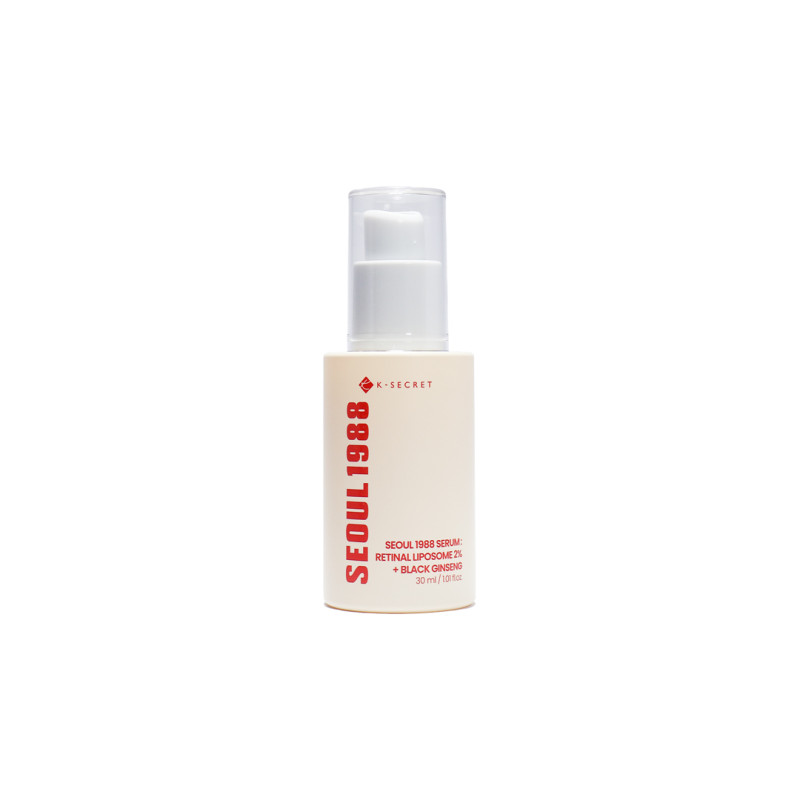
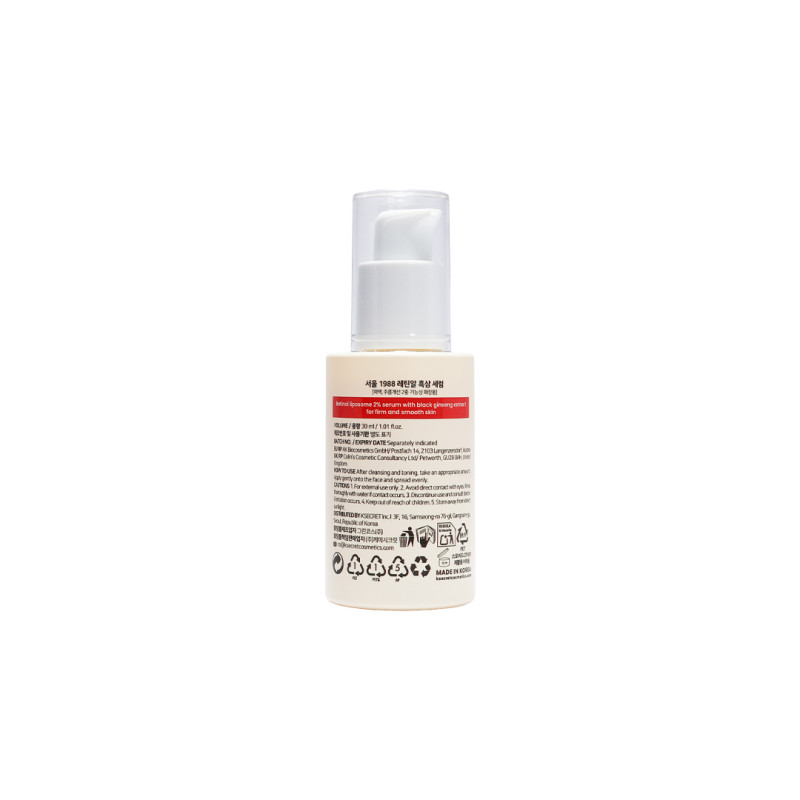
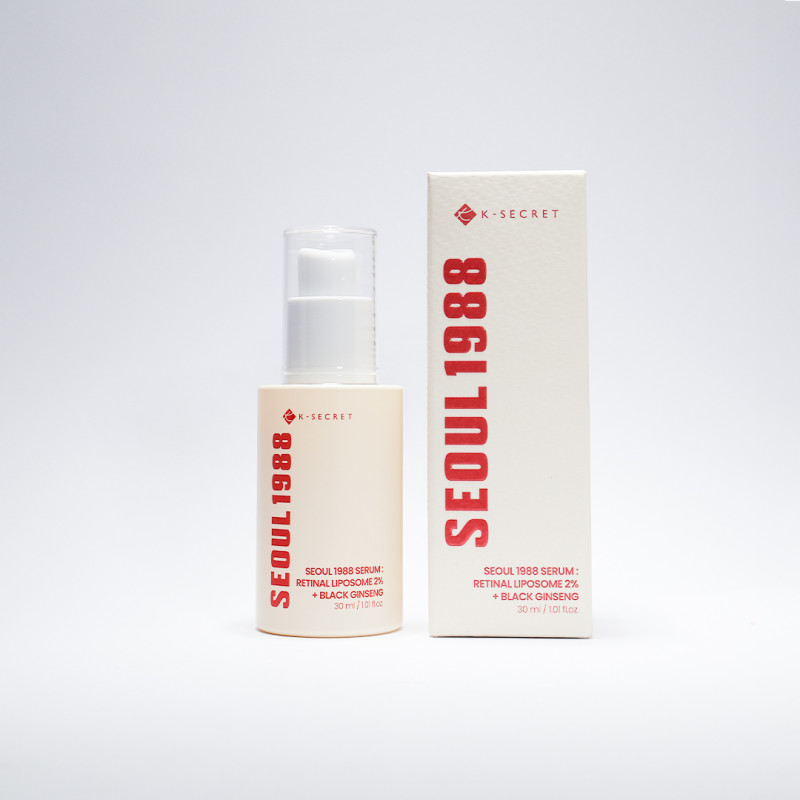
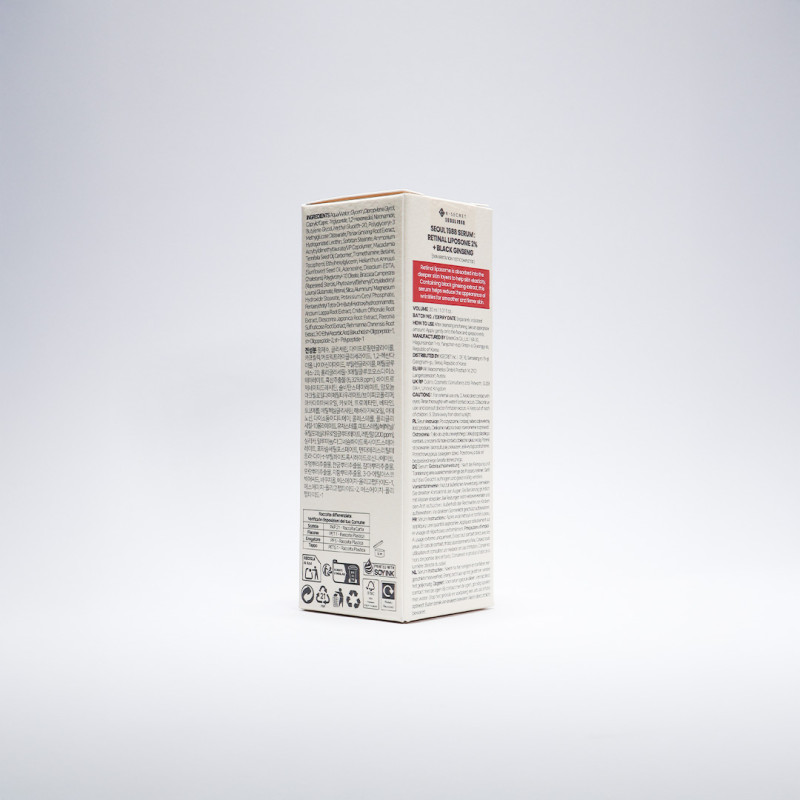
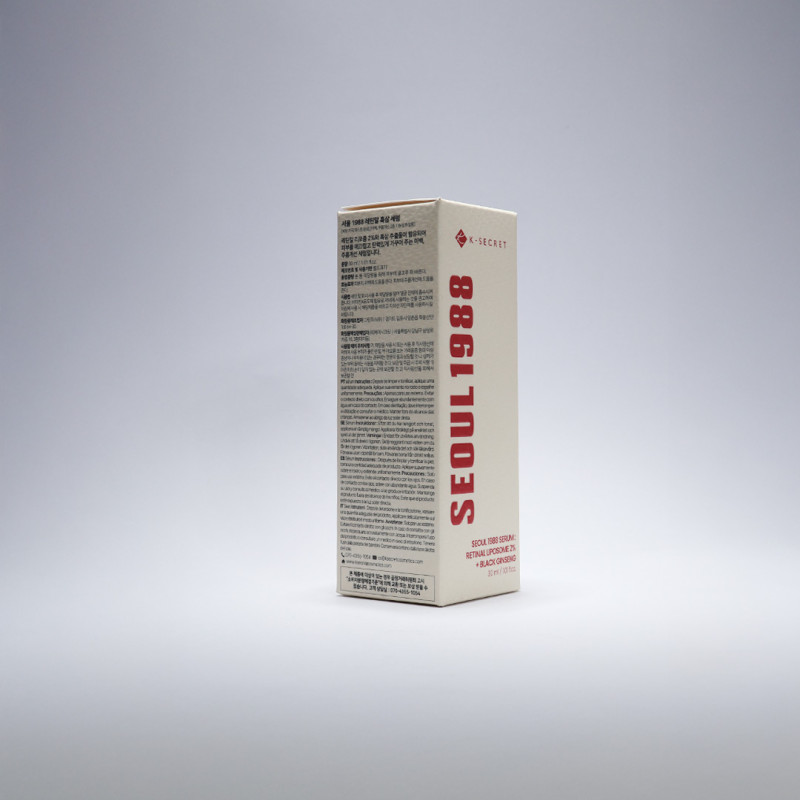
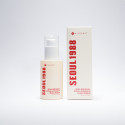
K-SECRET Seoul 1988 Serum: Retinal Liposome 2% + Black Ginseng 30 ml
৳1,700
K-SECRET Seoul 1988 Serum: Retinal Liposome 2% + Black Ginseng ত্বকের ফাইন লাইন, রিঙ্কেল ও অসম টেক্সচারের যত্নে সহায়ক। Retinal, Niacinamide ও Black Ginseng ত্বক মসৃণ, উজ্জ্বল ও হাইড্রেটেড রাখতে সাহায্য করে।
- Brand: Cos De BAHA
- Product Code:
- SKU: 8809695240508
- Availability: In Stock
Description
K-SECRET Seoul 1988 Serum: Retinal Liposome 2% + Black Ginseng is a Korean anti-aging facial serum built around a liposome-encapsulated retinal complex, black ginseng extract and a dual functional cosmetic registration granted by Korea’s Ministry of Food and Drug Safety.
That registration is the most useful thing on the bottle, and this page explains exactly what it tells you — including one detail the product name does not.
The formula also contains Niacinamide, Adenosine, Bakuchiol, three growth-factor peptides, a Vitamin C derivative and a lipid-based moisturizing system, in a 30ml opaque pump bottle.
Table of Contents
Why Choose This Serum?
Korea’s Dual Functional Registration — What It Actually Certifies
“Retinal Liposome 2%” — What the 2% Means
How This Formula Protects the Retinal
Black Ginseng at the 10th Position
Bakuchiol and the Peptides — Where They Sit
Key Benefits
Key Ingredients and Their Positions
Suitable Skin Types
How to Use — And How Often
Recommended Skincare Routine
Precautions
Product Details
Buy This Serum in Bangladesh
Official Source
Frequently Asked Questions
Why Choose K-SECRET Seoul 1988 Serum?
It Carries a Korean Government Registration
The bottle is marked as a dual functional cosmetic for brightening and wrinkle improvement. In Korea, that is not a marketing phrase — it is a registration with the Ministry of Food and Drug Safety that requires a specific approved active at a specific concentration.
Two of this serum’s ingredients hold that certification, and the section below names them and explains what concentrations the registration implies.
It Uses Retinal, Not Retinol
Retinal (retinaldehyde) sits one metabolic conversion step from retinoic acid, where retinol needs two. This is a real chemical difference — though, as this page explains, it does not automatically make any given retinal product stronger than any given retinol product.
The Retinal Is Properly Protected
Retinal degrades in light and air. This formula contains three separate stabilizing ingredients and ships in an opaque pump bottle rather than a dropper. That is a formulation and packaging decision that costs money and tells you the manufacturer took the ingredient seriously.
Black Ginseng Is Genuinely High in the Formula
Panax Ginseng Root Extract sits at the tenth position of forty-one ingredients — above every oil, every emollient and every other botanical in the list.
What We Will Be Straight With You About
The “2%” in the product name is the liposome complex, not the retinal. The retinal itself sits at the twenty-seventh position. This page explains what that means and why the serum is better understood as a gentle, beginner-appropriate retinal than a high-strength one.
Korea’s Dual Functional Registration — What It Actually Certifies
The Korean panel on the bottle carries this designation:
Dual Functional Cosmetic — Brightening and Wrinkle Improvement
What That Means
Korea regulates functional cosmetics tightly. To carry a wrinkle-improvement or brightening designation, a product must contain one of a short list of government-approved actives, at the approved concentration, and the formulation must be registered.
It is not a claim the brand can simply print. It has to be earned.
Which Ingredient Carries the Brightening Registration
Niacinamide, at the sixth position.
Korea’s approved brightening list includes niacinamide at 2 to 5 percent. The only other approved brightening ingredient in this formula is 3-O-Ethyl Ascorbic Acid, which sits at the thirty-seventh position — far too low to be the registered active.
So the registration itself tells you this serum contains niacinamide somewhere between 2% and 5%, even though the brand does not print a figure. That is a useful, verifiable floor on a real, working ingredient.
Which Ingredient Carries the Wrinkle Registration — And This Is the Interesting Part
Korea approves exactly four actives for wrinkle improvement:
Retinol 2,500 IU/g
Retinyl Palmitate 0.05%
Adenosine 0.04%
Polyethoxylated Retinamide 0.05–0.2%
Retinal is not on that list.
Which means the wrinkle-improvement registration on this bottle is carried by Adenosine, at the twenty-first position — not by the retinal the product is named after.
Is That a Problem?
No — but it is worth understanding.
Retinal is a legitimate, well-studied cosmetic retinoid. Korea’s approved list simply predates its widespread cosmetic use and has not been extended to include it. The absence of retinal from the list is a regulatory fact, not a verdict on the ingredient.
What it does mean is this: the certification on the box is evidence for the adenosine and the niacinamide. It is not evidence for the retinal. The retinal has to be judged on its own, which the next section does.
“Retinal Liposome 2%” — What the 2% Means
It Is Not 2% Retinal
The 2% refers to the retinal liposome complex — the whole raw material — not to the retinal inside it.
A retinal liposome raw material is mostly lipids, carrier fluid and encapsulation material. The retinal is a small fraction of it.
And the Ingredient List Confirms This
Ingredient order is regulated information. Here is where retinal actually sits:
6th Niacinamide (2–5%, per the registration)
18th Tocopherol
21st Adenosine (0.04%, per the registration)
23rd Cholesterol
27th Retinal
Twenty-seventh of forty-one. If this serum contained 2% retinal, it would sit above the niacinamide, not twenty-one places below it.
For reference, effective cosmetic retinal is typically used at 0.05% to 0.1%, and 0.1% is about the strongest available over the counter. The retinal here is well below one percent.
Retinal Versus Retinol — The Honest Comparison
Retinal converts to retinoic acid in one step; retinol needs two. That is a real advantage, per unit.
But it does not mean every retinal product beats every retinol product. A well-formulated 0.5% retinol will outperform a trace-level retinal. Concentration, stability and formulation decide the outcome — not the name of the molecule.
So Who Is This Serum Actually For?
Beginners, and people whose skin does not tolerate stronger retinoids.
That is not a criticism. A gentle retinal you can actually use three nights a week beats a strong one that makes your face peel and sits in a drawer. Combined with the 2–5% niacinamide and the certified adenosine, this is a sensible, well-tolerated entry point into retinoid skincare.
What it is not is a high-strength retinal treatment, and anyone buying it expecting that will be disappointed.
How This Formula Protects the Retinal
Retinal is one of the more fragile cosmetic ingredients. It degrades on exposure to light, air and heat, and a degraded retinoid does nothing at all.
This formula addresses that in three ways, and the packaging adds a fourth.
1. Tocopherol — 18th Position
Vitamin E, a well-established antioxidant that helps protect oxidation-sensitive ingredients in a formula.
2. Disodium EDTA — 22nd Position
A chelating agent that binds trace metal ions. Metal ions catalyze the oxidation of retinoids, so removing them extends the active’s life.
3. Pentaerythrityl Tetra-Di-t-Butyl Hydroxyhydrocinnamate — 31st Position
A dedicated antioxidant stabilizer, included specifically to protect oxidation-prone ingredients. Its presence is a clear signal that the formulator designed around retinal degradation rather than ignoring it.
4. The Opaque Pump Bottle
This matters more than most people realize. A dropper bottle draws fresh air into the product at every use, and clear glass lets light in. An opaque bottle with a pump does neither.
For a retinal product, this is the correct packaging, and it is not the cheapest option.
Hydrogenated Lecithin — 11th Position
Worth noting alongside the above: lecithin is the material liposomes are made from, and it sits at the eleventh position. Its placement is consistent with a genuine liposomal system rather than a claim with nothing behind it.
Black Ginseng at the 10th Position
The Position Is Real
Panax Ginseng Root Extract sits at the tenth position of forty-one ingredients. It is above the hydrogenated lecithin, the macadamia oil, the betaine, the tocopherol and every other botanical in the formula.
For a named hero botanical, that is where you want to find it. Compare this to products where the headline extract turns up in the bottom third.
What Ginseng Contributes
Ginseng root contains ginsenosides, the compounds responsible for most of its studied activity. In skincare it is used as an antioxidant and skin-conditioning botanical, and it has a long history in Korean formulation.
One Honest Limitation
Black ginseng is ginseng that has been repeatedly steamed and dried, a process said to change its ginsenoside profile. But there is no separate INCI name for it — black ginseng and ordinary ginseng are both declared as Panax Ginseng Root Extract.
So the ingredient list cannot confirm the “black” part. What does support it is the Korean packaging, which states black ginseng directly. We are telling you where the evidence comes from so you can weigh it yourself.
Bakuchiol and the Peptides — Where They Sit
This formula lists forty-one ingredients, several of which are familiar names. Position tells you which ones are doing work.
Bakuchiol — 38th Position
Bakuchiol is a plant-derived ingredient studied as a gentler alternative in anti-aging skincare. The studies that support it generally use 0.5% to 2%.
At the thirty-eighth position of forty-one, this is a trace-level inclusion. It is on the label; it is not a second active.
The Three Peptides — 39th, 40th and 41st Positions
These are the last three ingredients in the entire list. They are growth-factor peptides:
sh-Oligopeptide-1 Epidermal Growth Factor (EGF)
sh-Oligopeptide-2 Insulin-like Growth Factor (IGF-1)
sh-Polypeptide-1 Fibroblast Growth Factor (FGF-1)
The “sh-” prefix means synthetic human — these are produced by fermentation, not derived from animals.
Listing three growth factors is a common pattern in Korean serums, and they are almost always at the very end of the list, as here. They are a genuine addition, at genuinely small amounts.
3-O-Ethyl Ascorbic Acid — 37th Position
A stable Vitamin C derivative, at a trace level. This is not a Vitamin C serum, and should not be bought as one.
The Honest Summary
The ingredients doing the work here are the niacinamide at the sixth position, the ginseng at the tenth, the adenosine at the twenty-first, and the retinal at the twenty-seventh. Everything below that is supporting cast.
Key Benefits of This Serum
Korean Dual Functional Registration: Certified for brightening and wrinkle improvement by Korea’s MFDS.
Niacinamide at 2–5%: Implied by the registration itself — a real working concentration at the 6th position.
Certified Wrinkle Active: Adenosine at Korea’s approved 0.04%.
Gentle Retinal: A beginner-appropriate retinoid in a properly stabilized formula.
Black Ginseng at the 10th Position: The highest-placed botanical in the formula.
Three-Layer Stabilization: Tocopherol, Disodium EDTA and a dedicated antioxidant stabilizer.
Opaque Pump Packaging: The correct format for a light- and air-sensitive active.
Liposomal Delivery: Supported by hydrogenated lecithin at the 11th position.
Barrier-Supporting Lipids: Cholesterol, rapeseed sterols, macadamia and sunflower seed oils.
Hydration Base: Glycerin at the 2nd position, plus dipropylene glycol, butylene glycol and betaine.
No Added Fragrance: Verified across all 41 ingredients.
30ml Pump Bottle.
Key Ingredients and Their Positions
Glycerin — 2nd Position
The formula’s main humectant, placed high. Hydration support matters in any retinoid routine.
Niacinamide — 6th Position
At 2–5%, per Korea’s brightening registration. Supports even skin tone, visible pore appearance and barrier function. Arguably the most reliably effective ingredient in this bottle.
Panax Ginseng Root Extract — 10th Position
The highest-placed botanical. A substantial inclusion for a named hero ingredient.
Hydrogenated Lecithin — 11th Position
The liposome-forming material, supporting the delivery-system claim.
Macadamia Ternifolia Seed Oil — 14th Position
A rich emollient high in monounsaturated fatty acids.
Betaine — 17th Position
A gentle humectant that supports comfort alongside the retinal.
Tocopherol — 18th Position
Vitamin E, working as both a skin antioxidant and a formula stabilizer.
Helianthus Annuus (Sunflower) Seed Oil — 20th Position
A linoleic-acid-rich oil that supports barrier comfort.
Adenosine — 21st Position
Korea’s certified wrinkle-improvement active, at the approved 0.04%. The ingredient actually carrying the wrinkle designation on this box.
Cholesterol — 23rd Position
One of the three lipid classes in the skin barrier, alongside ceramides and fatty acids. See the note below regarding its source.
Retinal — 27th Position
The product’s namesake, at a trace-to-low level. Covered in full above.
Pentaerythrityl Tetra-Di-t-Butyl Hydroxyhydrocinnamate — 31st Position
A dedicated antioxidant stabilizer protecting the retinal.
Five Traditional Root Extracts — 32nd to 36th Positions
Burdock, cnidium, Japanese yam, tree peony and rehmannia — a traditional Korean herbal grouping, at small amounts.
Bakuchiol — 38th, and the Peptides — 39th to 41st
Trace-level inclusions. Covered above.
A Note on Cholesterol for Customers in Bangladesh
Cosmetic cholesterol is most commonly derived from lanolin, which comes from sheep’s wool. Plant-derived and synthetic versions also exist, and the ingredient declaration does not specify which is used here.
This means the serum is not vegan. On the question of halal status, lanolin obtained from living sheep is considered acceptable by most scholars, but opinions differ and the source here is not stated. We are telling you the ingredient is present and where it usually comes from, so you can decide according to your own practice.
The three peptides are produced by fermentation and are not animal-derived.
What Is Not In It
No fragrance. No alcohol denat. No essential oils. No AHA or BHA. No SPF.
Which Skin Types Is This For?
A Good Match
Retinoid Beginners: The clearest fit. A gentle retinal with niacinamide and lipids behind it.
Early Signs of Aging: Fine lines, loss of smoothness, texture changes.
Uneven Skin Tone and Dullness: The 2–5% niacinamide is the reliable performer here.
Anyone Who Found Stronger Retinoids Too Harsh: This is a realistic step down.
Normal and Combination Skin: Comfortable with the lipid base.
Dry Skin: The macadamia oil, sunflower oil, cholesterol and sterols help considerably.
Fragrance-Sensitive Users: Genuinely fragrance-free.
Use With Care
Sensitive Skin: Patch-test and start at two nights a week. Encapsulation reduces irritation but does not eliminate it.
Oily Skin: Workable, but the oils and emollients may feel heavy for some.
Acne-Prone Skin: Retinoids are relevant to acne, but this is a cosmetic serum, not a treatment.
Not the Right Choice
Anyone Pregnant or Trying to Conceive: Retinoid skincare is avoided during pregnancy. Please see the precautions.
Anyone Wanting a High-Strength Retinal: This is not that product.
Anyone Already Using a Prescription Retinoid: Do not layer retinoids.
Currently Irritated or Peeling Skin: Wait until it has settled.
How to Use — And How Often
Build Up Gradually
Weeks 1–2 Two nights a week
Weeks 3–4 Every other night, if there is no irritation
After That Nightly only if your skin stays completely comfortable
Steps
Cleanse in the evening.
Apply toner if you use one, and let the skin settle.
Dispense one pump. That is enough for the whole face.
Spread gently over the face, avoiding the eyelids, the area immediately around the eyes, and the lips.
Moisturize. Always, on retinal nights.
Sunscreen every morning, SPF 30 or higher.
The Buffering Method for Sensitive Skin
Apply your moisturizer first, wait a few minutes, then apply the serum over it. This slows absorption and reduces irritation — a useful option in the first few weeks.
Keep the Bottle Closed and Out of the Light
The opaque pump protects the retinal, but only if you let it. Store it in a drawer or cupboard rather than on a sunny windowsill.
Give It Time
Skin feel and hydration change within weeks. Texture and fine lines take two to three months of consistent use. Judge it then.
Recommended Skincare Routine
Evening — Serum Nights
Step 1 – Cleanse. Step 2 – Toner. Step 3 – This serum. Step 4 – Moisturizer.
Evening — Other Nights
Step 1 – Cleanse. Step 2 – Toner. Step 3 – A hydrating or barrier serum. Step 4 – Moisturizer.
Morning
Step 1 – Cleanse. Step 2 – Toner. Step 3 – Serum if you use one. Step 4 – Moisturizer. Step 5 – Sunscreen.
Combining With Other Actives
Vitamin C: Morning. Keep the retinal for evenings.
AHA or BHA: Not on the same night. Alternate them.
Other Retinoids: Do not layer. Choose one.
Niacinamide Serums: This already contains 2–5%. A second one is unnecessary.
Ceramide Moisturizers: An excellent pairing. The formula contains cholesterol and sterols but no ceramides, so a ceramide moisturizer completes the lipid set.
Important Usage Tips and Precautions
Do not use during pregnancy or while trying to conceive. Retinoid skincare is avoided in pregnancy as a precaution. If you are breastfeeding, speak to a doctor before use.
Introduce gradually — two nights a week to start.
Patch-test before first use.
Always moisturize on the nights you use it.
Use sunscreen every morning. Retinoids increase sun sensitivity.
Do not layer with another retinoid, or with acids on the same night.
Temporary dryness, mild flaking or redness can occur in the first weeks. Persistent stinging, burning or swelling is not normal — stop and let the skin recover.
Avoid the eyelids, the immediate eye area and the lips.
Do not apply to broken, inflamed, peeling or sunburned skin.
Store away from direct sunlight and heat. Retinal degrades in light.
Keep the pump closed. Do not decant into another container.
Contains cholesterol, which is commonly lanolin-derived. See the ingredient note above.
For external use only.
This is a cosmetic serum, not a treatment for acne, melasma or any medical skin condition. Deep or depressed acne scars need professional treatment.
Keep out of reach of children.
Product Details
Brand K-SECRET
Product Name K-SECRET Seoul 1988 Serum: Retinal Liposome 2% + Black Ginseng
Product Line Seoul 1988
Product Category Skin Care / Serum / Anti-Aging Serum
Product Type Leave-On Retinal Treatment Serum
Korean Functional Registration Dual Functional Cosmetic — Brightening and Wrinkle Improvement (Korea MFDS)
Registered Brightening Active Niacinamide — 6th Position, 2–5% per Korean Approval
Registered Wrinkle Active Adenosine — 21st Position, 0.04% per Korean Approval
Headline Retinoid Retinal (Retinaldehyde) — 27th Position
Retinal Liposome Complex 2% of the Formula — This Is the Complex, Not the Retinal
Pure Retinal Concentration Not Published; Ingredient Position Indicates Well Below 1%
Headline Botanical Black Ginseng (Panax Ginseng Root Extract) — 10th Position
Retinal Stabilizers Tocopherol (18th), Disodium EDTA (22nd), Pentaerythrityl Tetra-Di-t-Butyl Hydroxyhydrocinnamate (31st)
Liposome Material Hydrogenated Lecithin — 11th Position
Barrier Lipids Cholesterol, Rapeseed Sterols, Macadamia Seed Oil, Sunflower Seed Oil
Peptides sh-Oligopeptide-1, sh-Oligopeptide-2, sh-Polypeptide-1 — 39th to 41st Positions
Total Ingredients 41
Added Fragrance None — Verified Across All 41 Ingredients
Alcohol None
Vegan No — Contains Cholesterol, Commonly Lanolin-Derived
Texture Lightweight Emulsion Serum
Main Skin Concerns Fine Lines, Uneven Texture, Dullness, Uneven Tone, Visible Pores
Best For Retinoid Beginners and Early Signs of Aging
Not Recommended For Pregnancy or Trying to Conceive; Anyone Using Another Retinoid
Product Step After Toner, Before Moisturizer
Recommended Use Evening Only — Start 2 Nights a Week and Build Up
Packaging Opaque Pump Bottle With Outer Carton
SPF Protection None
Available Size 30ml
Product SKU 8809695240508
Manufacturer GreenCos Co., Ltd., Republic of Korea
Responsible Distributor K-Secret Inc., Gangnam-gu, Seoul, Republic of Korea
Country of Origin South Korea
Buy K-SECRET Seoul 1988 Serum in Bangladesh
Buy K-SECRET Seoul 1988 Serum: Retinal Liposome 2% + Black Ginseng in Bangladesh from KC BAZAR. A Korean dual functional registered serum for brightening and wrinkle improvement, with niacinamide at 2–5%, black ginseng at the tenth position and a stabilized retinal complex, in a 30ml opaque pump bottle — with nationwide home delivery.
Explore more Korean Skincare at KC BAZAR.
Official Source
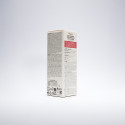
The bottle carries the Korean designation “Seoul 1988 Retinal Black Ginseng Serum — Dual Functional Cosmetic for Brightening and Wrinkle Improvement,” a registration granted by Korea’s Ministry of Food and Drug Safety.
The English panel reads: “Retinal liposome 2% serum with black ginseng extract for firm and smooth skin”, with VOLUME 30 ml / 1.01 fl.oz. and MADE IN KOREA. The barcode is 8809695240508.
The Korean regulatory panel names GreenCos Co., Ltd. as the cosmetics manufacturer and K-Secret Co., Ltd. as the responsible distributor, with the company address given as 3F, 16 Samseong-ro 76-gil, Gangnam-gu, Seoul. Responsible persons are also listed for the European Union and the United Kingdom.
The ingredient declaration places Niacinamide at the sixth position, Panax Ginseng Root Extract at the tenth, Adenosine at the twenty-first and Retinal at the twenty-seventh of forty-one ingredients — the basis for the assessment on this page.
Korea’s approved wrinkle-improvement actives are retinol, retinyl palmitate, adenosine and polyethoxylated retinamide; its approved brightening actives include niacinamide at 2–5%. This is why the registration on the bottle identifies the adenosine and the niacinamide as its certified actives.
K-SECRET — Official Website
Frequently Asked Questions
1. Does this serum contain 2% retinal?
No. The 2% is the retinal liposome complex — the whole raw material — not the retinal inside it. Retinal sits at the twenty-seventh position of forty-one ingredients, which confirms it is well below one percent.
2. So how much retinal is in it?
The brand does not publish a figure. The ingredient position tells you it is a low, beginner-level amount — effective cosmetic retinal runs from about 0.05% to 0.1%, and this sits below the adenosine and the tocopherol.
3. What does the Korean dual functional registration mean?
It means Korea’s Ministry of Food and Drug Safety has certified the product for brightening and wrinkle improvement, which requires approved actives at approved concentrations. It is a regulatory approval, not a marketing claim.
4. Which ingredients carry that registration?
Niacinamide, at 2–5%, carries the brightening side. Adenosine, at 0.04%, carries the wrinkle side. Retinal is not on Korea’s approved wrinkle list, so it is not the certified active — though it is still a legitimate cosmetic retinoid.
5. How much niacinamide does it contain?
Between 2% and 5%. The brand does not print a number, but the Korean brightening registration requires niacinamide in that band, and niacinamide sits at the sixth position.
6. Is retinal stronger than retinol?
Per unit, yes — retinal is one conversion step from retinoic acid where retinol needs two. But that does not make every retinal product stronger than every retinol product. Concentration and formulation decide the result, and this retinal is at a low level.
7. Is this good for retinoid beginners?
Yes — this is its strongest fit. A gentle, well-stabilized retinal with 2–5% niacinamide and a lipid base behind it. Start at two nights a week.
8. Can I use it during pregnancy?
No. Retinoid skincare is avoided during pregnancy and while trying to conceive, as a precaution. Speak to a doctor if you are breastfeeding.
9. Can I use it every night?
Not at first. Two nights a week for the first fortnight, then every other night if your skin stays comfortable. Nightly use only once it is clearly well tolerated.
Food & Supplement


Some By Mi AHA. BHA. PHA 30 Days Miracle Acne Clear Foam 100 ml Some By Mi
৳1,350 Ex Tax: ৳1,350


Korean Hot Ramen 120 g
৳180 Ex Tax: ৳180


Natural Timbers Beauty Slim Diet 2pcs
৳0 Ex Tax: ৳0


